Key points to distinguish between lathes and turning and milling compound machines
1. Functional integration degree
Youdaoplaceholder0 lathe : Traditional lathes mainly focus on turning processes and have relatively single functions. It drives the workpiece to rotate through the spindle, and the tool feeds in a specific direction (such as axial or radial) to complete the cutting process of the workpiece. It is mainly used for processing rotary parts, such as the outer circle, inner hole, and end face of shaft and disc parts. For instance, a common ordinary lathe can perform basic turning operations, but for the processing of some complex shapes, multiple clamping and tool changes may be required.
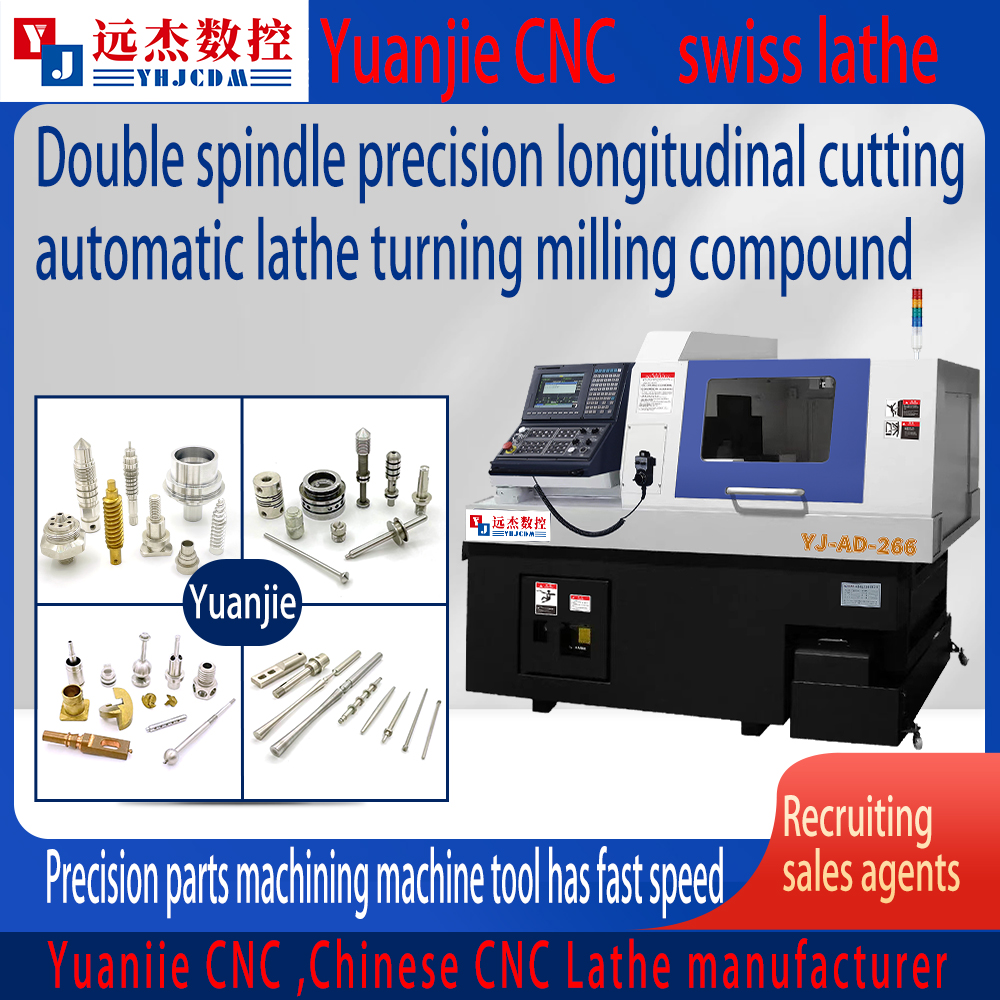
Youdaoplaceholder0 Turning and milling compound : integrates multiple processing methods such as turning and milling. It not only has the turning function of a lathe, but also can perform complex operations such as milling, drilling and tapping. In a single clamping, multiple processing procedures can be completed, significantly enhancing processing efficiency and accuracy. For instance, some high-end turning and milling compound machine tools can complete a series of processing such as turning, milling keyways and drilling of shaft parts on the same equipment.
2. Processing object
Youdaoplaceholder0 lathe : mainly designed for rotary parts with relatively simple and regular shapes. These parts usually have the characteristic of axial symmetry, and their dimensional and shape accuracy requirements can be met through turning processing. For instance, the crankshaft of a car engine, its journal and connecting rod journal, among other parts, can be precisely machined by a lathe.
Youdaoplaceholder0 turning and milling compound : suitable for processing parts with complex shapes and high precision requirements. It can handle parts with various features (such as planes, curved surfaces, hole systems, etc.), especially some asymmetric and irregular rotary or non-rotary parts. For complex impellers in the aerospace field, their blade shapes are intricate, featuring both curved surfaces and multiple hole systems. Using a turning and milling compound machine tool can complete most of the processing procedures in a single clamping.
3. Application fields
Youdaoplaceholder0 lathe : Widely used in general mechanical manufacturing industries, such as automotive parts manufacturing, hardware processing, etc. In these fields, the processing accuracy and complexity of parts are relatively low, and lathes can meet most production demands. For instance, common shaft parts are produced and used in general mechanical equipment.
Youdaoplaceholder0 turning and milling compound : It is more widely applied in industries with extremely high requirements for part precision and processing efficiency, such as aerospace, medical devices, precision instruments, etc. The parts in these industries usually have the characteristics of high precision and high complexity, and the advantages of turning and milling compound machine tools can be fully exerted. For instance, in the manufacturing of medical devices, when processing some small and high-precision parts, turning and milling compound machine tools can ensure the quality and performance of the parts.
Discussion and guidance
Do you think there will be a significant difference in operational difficulty between lathes and turning-milling compound machines? Or do you still want to know the differences between them in other aspects, such as cost, maintenance, etc.? Welcome to consult Yuanjie CNC


 Service
 Mobile website